
























































By Ayo Arowojolu

For Dr. Waheed Ogunjobi, the journey from an HND holder to a PhD graduate is more than a story of academic advancement. It is a testimony to the power of embracing change, acquiring new knowledge and building on a solid educational foundation.
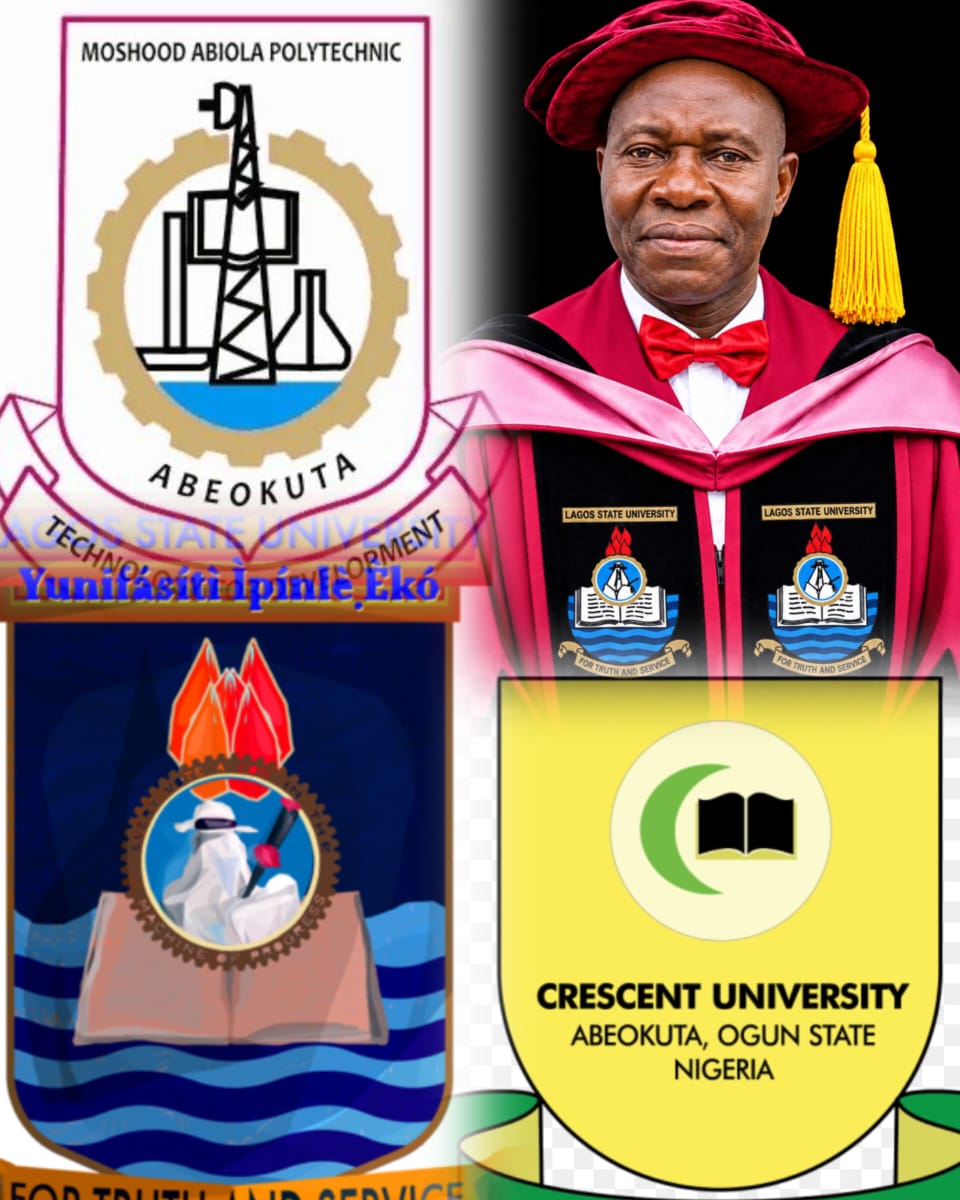
Ogunjobi, a media professional and alumnus of the Department of Mass Communication, Crescent University, Abeokuta, recently attained the prestigious Doctor of Philosophy degree. His achievement is particularly significant within the Crescent community because he is one of three graduates of the department who have gone on to earn PhDs, after also obtaining their Master’s degrees from the university.
Although the three alumni pursued their doctoral studies at different universities, their common academic roots can be traced to Crescent University, where they received their undergraduate and Master’s education.
For Ogunjobi, the journey began with a decision to return to university almost 13 years after obtaining his Higher National Diploma.
Looking back, he describes his decision to pursue a Bachelor’s degree at Crescent University as a turning point in his career.
“I had initially lived in denial about needing a degree,” he recalled. But returning to the university opened his eyes to how significantly the Mass Communication discipline had evolved since his HND days.
Several courses that were not available during his earlier training had become part of the curriculum. Rather than seeing this as a disadvantage, Ogunjobi embraced the opportunity to acquire new knowledge and develop a broader intellectual foundation.
His experience also reinforced a personal philosophy about responding to change. “Most often than not, when we need to embrace changes, we live in denial,” he said. “It is better to accept the reality of the time and move with the trend and not to allow the trend subsume you or be caught napping.”
That mindset would become important as he progressed from undergraduate study to postgraduate education and eventually doctoral research.
A foundation for advanced scholarship
Ogunjobi believes one of the greatest advantages Crescent University gave him was the early exposure to academic writing, critical thinking and research. The foundation became particularly useful when he proceeded to the Master’s level.
His Master’s programme was seminar-based, requiring considerable participation, presentation, critical engagement with scholarly materials and academic writing. According to him, the training he received at Crescent had already prepared him for that mode of learning.
“By the time I enrolled for my Master’s programme, Crescent had already prepared me for that style of engagement,” he said.
The preparation became even more valuable when he eventually embarked on doctoral studies.
“By the time I enrolled for my PhD, it felt like a natural progression,” Ogunjobi recalled. He said his undergraduate and Master’s research experiences had given him a working knowledge of academic writing, critical analysis and scholarly publication.
Both his B.Sc. project and Master’s dissertation, he explained, were published with the support of the department and its journals. That early exposure to the process of transforming research into coherent and publishable academic work, he believes, removed much of the uncertainty that often accompanies advanced research.
“Having gone through the process of turning a long essay into a coherent and meaningful thesis early, I found the PhD journey much smoother,” he said.
Three alumni, one academic foundation
The emergence of three Crescent University Mass Communication alumni as PhD holders represents, in Ogunjobi’s view, an indication of the quality of training provided by the department.
While the three pursued their doctoral degrees at different universities, they share a common educational heritage: their undergraduate and Master’s training at Crescent University.
“You can say that again!” Ogunjobi said when asked what the development says about Crescent’s culture of academic excellence.
He argued that Crescent graduates have consistently distinguished themselves in universities and professional environments within Nigeria and abroad. For him, the achievement is not an isolated development but part of a continuing tradition of academic and professional advancement among graduates of the institution.
Beyond the classroom, Ogunjobi said Crescent’s Mass Communication programme also exposes students to the practical realities of the profession. “Crescent University offers a practical blend that goes beyond classroom learning,” he explained.
According to him, students are not trained merely to write news reports and feature stories. The department’s various publications also serve as practical training grounds where students develop professional competence while gaining early exposure to entrepreneurship.
It is this combination of theory, practice and enterprise that Ogunjobi believes gives Crescent graduates an advantage.
The practical orientation, combined with academic discipline, provided a useful foundation for his later transition into advanced scholarship.
Media framing and the challenge of national development
Ogunjobi’s doctoral research also reflects the intersection between his professional experience in the media and his interest in communication and development.
His PhD research focused on “Newspaper Framing of the Rural Grazing Area Policy in Nigeria.”
The study examined the way newspapers framed the policy and the implications of such media framing for public perception, policy communication and national development.
His findings, he said, revealed significant gaps in policy communication and highlighted the important role of the media in shaping how citizens understand public policies and development issues. The research also emphasised the need for data-driven journalism and conflict-sensitive reporting, particularly when the media is covering issues capable of generating tension or controversy.
“Effective communication is key to development, and the media has a significant role to play in this process,” Ogunjobi said. “My research underscores the importance of media framing in shaping public perception and influencing policy formulation and outcomes.”
The research therefore goes beyond the conventional boundaries of academic inquiry. It speaks to the practical responsibility of the media in a society where the manner in which policies are presented can influence public understanding and wider responses to them.
For Ogunjobi, doctoral research provided an opportunity to examine that relationship more closely and contribute to the body of knowledge on media, communication and national development.
A message to Crescent students
Having travelled the academic route from HND to B.Sc., Master’s and ultimately PhD, Ogunjobi’s message to current Crescent University students is simple: do not merely inherit the standards established by those before you; strive to surpass them. “Take a cue from those who came before you, and not only meet the standards that have been set, but surpass them,” he advised.
He believes the university already has the resources required to nurture future scholars and professionals. “The facilities are there. The array of scholars is there,” he said.
For Ogunjobi, the fact that Crescent University has now produced its own first set of PhD graduands is especially significant. It represents, in his view, evidence that the university is not only preparing students to pursue advanced studies elsewhere but is also developing the capacity to nurture doctoral scholarship within its own academic environment.
“The university recently produced its first set of PhD graduands,” he noted. “That shows Crescent is not just keeping pace elsewhere, it is also building capacity at home.” “Charity, indeed, has begun at home.”
From a decision to return to university almost 13 years after his HND to the attainment of a doctorate, Ogunjobi’s story demonstrates how academic growth can continue at different stages of a person’s professional life. His experience also highlights the enduring value of a strong educational foundation.
For him, Crescent University provided not only a degree but the research culture, intellectual confidence and practical exposure that helped make subsequent academic challenges more manageable.
And as three of its Mass Communication alumni move into the ranks of PhD holders, the story of Crescent’s academic influence continues to extend beyond its classrooms—into the universities, professions and scholarly communities where its graduates are making their contributions.