


























































News

Fear Can Weaken Faith, Distort Thinking, Prevent Action — Ven Fajobi
Fear can weaken faith, produce qdoubt, distort human thinking and prevent people from taking necessary action, Ven. Olukunle Aremu Fajobi...
Read more
Decoupling Sovereignty Index (1): The Anatomy of Becoming Nobody
By Max Amuchie | The Sunday Stew On 7 June 2026, this column unveiled the Decoupling Sovereignty Index (DSI) as the quantitative extension of the Trinity of Sovereignty Decay (TSD) theory, formerly known as the Trinity of State Decay. It is a measurement instrument designed to track the degree to which a state's formal authority has separated from its practical, lived reality on the ground. But the index measures a condition with a human face—and that face belongs to a peculiar kind of disappearance: one that does not require a person to die. A person can remain alive, remain within the borders of a country, retain a name, a nationality and perhaps even a national identity document, and yet become progressively invisible to the institutions that are supposed to make citizenship meaningful. The person has not left the country. The state has not officially ceased to exist. The constitution may still be in force, parliament—or, in the case of Nigeria, the State Assembly—may still sit, courts may still open their doors, police stations may still bear the name of the state, ministries may still issue statements, and elections may still be conducted. And yet, somewhere within the territory, sovereignty has begun to thin out. The question is not simply whether a state exists. The deeper question is where, how, and to what degree sovereignty reaches the individual. What happens when the state still claims a person but can no longer reliably see, protect, serve or represent them? Perhaps the most concise answer is that they begin to become nobody. Not nobody in the philosophical sense of non-existence. Nobody in the institutional sense. The DSI Begins With the Zone DSI does not begin with the country as its unit of observation. It begins with the zone—the sub-national space in which sovereignty is actually experienced. A country may remain formally sovereign while sovereignty is experienced very differently across its territory. A national government can exercise effective authority in one part and encounter competing authority, weak institutional reach or negotiated compliance in another. The country provides the sovereign frame; the zone provides the analytical field. The question, therefore, is not simply whether the state exists, but where—and for whom—it actually exists. That distinction is essential. An observation about the Port-au-Prince Metropolitan Zone is not a statement that Haiti as a whole has ceased to function as a sovereign state. An observation about Catatumbo is not a statement about Colombia in its entirety, and an observation about Zamfara is not a description of Nigeria as a whole. The comparative question is therefore not "Which country has failed?" It is this: what happens to sovereignty inside particular zones when the state's formal territorial claim becomes detached from its effective institutional reach? Three Zones, Three Continents Consider the Port-au-Prince Metropolitan Zone in Haiti, the Catatumbo Zone in Colombia and the Zamfara Zone in Nigeria. They differ in geography, history, political systems and the forms of insecurity they have experienced. They are not three versions of the same crisis. They are three configurations of decoupling. Port-au-Prince: territorial sovereignty contested. Haiti remains a sovereign state, with international recognition, constitutional institutions and territorial claims. But in parts of the metropolitan area, armed groups have acquired an extraordinary capacity to determine how people move, trade, work and access essential services. When an armed group controls a road, decides who may pass, extracts revenue or determines which population can remain in a neighbourhood, it inserts itself between the state and the citizen. The resident's question becomes brutally practical: whose authority determines whether I can move, trade, work or remain here? That is a DSI question. The person's nationality has not changed, but the lived geography of sovereignty may have. Catatumbo: sovereignty in competition. In Colombia's Norte de Santander, the state has not simply disappeared. Armed organisations have competed for territorial and social control alongside formal institutions, in a region shaped by armed conflict, illicit economies and displacement. The escalation of violence in early 2025 produced mass displacement and severe humanitarian consequences. What matters for DSI is that different forms of authority operate within the same space. The state retains legal sovereignty, an armed organisation may control movement in a locality, an illicit economy may determine livelihoods, and a community may build its own mechanisms of protection. The citizen lives within overlapping systems of authority. This is not the disappearance of sovereignty but the fragmentation of its lived expression. Zamfara: the negotiated space. In Zamfara, the state remains present: institutions, security agencies and political authority are all formally intact. Yet persistent bandit violence, displacement and attacks on rural communities have created environments in which survival can require strategies beyond ordinary reliance on formal institutions. In some instances, communities have negotiated locally with armed groups. The DSI question is not whether such negotiations are legitimate or lawful. It is why a community reaches the point of feeling compelled to negotiate its security outside the state's formal architecture. The community may not have rejected the state. It may simply have found that survival has acquired another institutional address. And once survival acquires another address, sovereignty has begun to move. These are not a league table of state failure, and DSI is not making one. Nor should every alternative institution be treated as the same phenomenon. A community organisation providing emergency support is not analytically identical to an armed group controlling territory. An informal market is not criminal governance. A negotiated local arrangement is not automatically the displacement of state authority. ...
Read more
Policy Phobia: Why Adebutu fears manifesto more than ancestry
By Segun Olatunji In the grand theatre of political desperation, the opposition Peoples Democratic Party in Ogun State has finally...
Read more
Prepare Children For Jobs of Tomorrow, Ademosu Urges Private School Owners
A brand practitioner and education advocate, Dr. Eddy A. Ademosu, has urged educational authorities and promoters to prepare children not...
Read more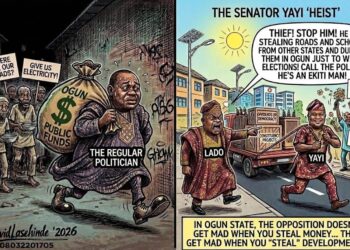
On Lado’s Odogbolu campaign comedy meltdown
By Segun Olatunji Welcome to the theatre of the desperate, otherwise known as the Peoples Democratic Party’s (PDP) premature campaign...
Read more
‘Let Facts Prevail’: Parents Fire Back at Educ Minister Over Unity Schools, Demand Answers to 12 Tough Questions
By Ayo Arowojolu For many Nigerian parents, the argument over the proposed concession of King’s College, Lagos, is no longer...
Read more
From HND in MAPOLY to PhD in LASU: Ogunjobi Credits Crescent University Foundation
By Ayo Arowojolu For Dr. Waheed Ogunjobi, the journey from an HND holder to a PhD graduate is more than...
Read more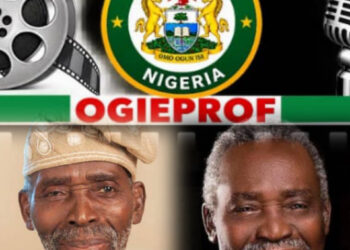
OGIEPROF Mourns Olu Jacobs, Says Ogun Actors, Entertainers Will Miss Him Dearly
The Ogun State Indigenes Entertainment Professionals Forum(OGIEPROF), an umbrella body for all indigene Ogun State Artist and Entertainers, in the...
Read more
Fajobi Challenges Christians: Don’t Ask What You Can Get, Ask Who You Can Bless
Christians have been urged to cultivate the habit of giving and generosity, not merely as a means of helping others...
Read more
Alhaji Nojeem Jimoh at 74: Tribute to My Egbon and Confidant,- By Ambassador Sarafa Tunji Isola
Today, I join family, friends, associates and well-wishers of Alhaji Nojeem Jimoh in celebrating a remarkable milestone — his 74th...
Read more







Recent News

Boiling Point is an online newspaper that has bias for reporting items of news that principally cut across politics, economy, general interests and public finance management/administration. Boiling Point holds dearly the journalism tenets of objectivity, fairness, balance and truth in reporting the news.