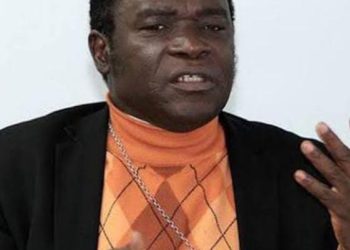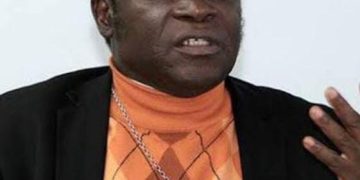

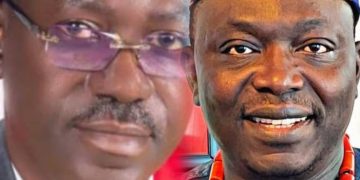
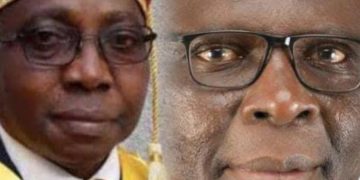
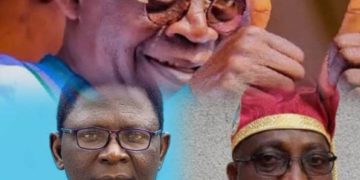
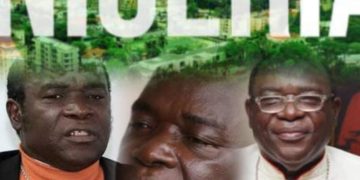


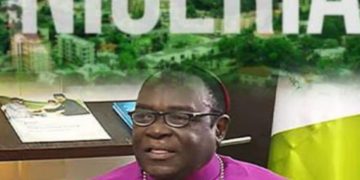













Contributing to the debate as to whether Nigeria’s destiny is beyond redemption, Catholic Bishop of Sokoto, Dr Mathew Kukah was emphatic that the current governance crisis and economic problems plaguing the country would soon birth a brand new nation beyond reproach.

Yet, the Cleric stated that a transformed Nigeria will not come through the trending culture of voiceferous lamentations and bad-mouthing of the country by the people.
Kukah, an advocate of ethical governance spoke during the 39th edition of the popular monthly interview discourse, Boiling Point Arena, hosted by a media professional, Dr Ayo Arowojolu.
The well-publicized programme was transmitted via Zoom and broadcast live on six radio stations across Lagos, Ogun and Delta States.
Bishop Kukah’s drift: “As far as I am concerned, this country is not where I would have wanted it to be. I totally and fundamentally disagree that Nigeria has failed. I think what has happened to us is the evolution of rising expectations. We have been too hard on ourselves.
“Most of the challenges we complain about are not peculiar to Nigeria. We complain too much about government. The peoples’ ability to protest, ability to threaten, ability to engage matters. Nigerians must develop the capacity to resist. If we say we want a better society, government is not the one that is going to give you a good society. But, government will respond to the pressure coming from ordinary citizens.
“Not for us to become despondent. What I am saying is that if we decide that we want a new Nigeria, we will have a new Nigeria. But we’re not going to have it by lamentation. We’re not going to have it by merely abusing ourselves and flogging ourselves. We are going to have the day we decide to become sufficiently disciplined and play by the rules. We must learn a culture of protest and the sacrifice that comes with it.”
Although Bishop Kukah admitted that successive Presidents have made some terrible mistakes through lastlustre leadership, he nonetheless stated: I agree we ought not to be where we are. But I think that on a very optimistic note, I believe that this country has achieved quite a lot of things.”
He adduced blames for the country’s retrogression to the hangover effects of prolonged military rule which interrupted the nation’s democracy in 1966.
He said further: “I think that, for me, I remain very, very cautiously optimistic about the future. What is very much ignored when we are talking about leadership
failure in Nigeria is that we pay very little attention to a very vital component of leadership, that is, the conveyor belt of intentions, namely the bureaucracy. Every country is as good as the bureaucracy that it has.
“There is something more to be said, which is elite responsibility or lack of responsibility. The reason why the country cannot grow is not because the ordinary people are not doing what they ought to do.They are not making the sacrifices.
“An elite that is not prepared to play by the rules.Elites that are not prepared to submit itself to the discipline that you require for nation building.The reality is that Nigerians are not generally committed to process and due process. We have refused to empower the discipline that is required to build the kind of country we want to build.
“What we are witnessing today is the result of our collective irresponsibility. So I think the day that all of us decide to play by the rules, to obey the laws, that’s when a new Nigeria will be birthed”.
Also speaking earlier while making a keynote speech as Chair of the duscourse, frontline traditional ruler, the Olowu of Owu Kingdom, Oba Prof Saka Matemilola maintained that Nigeria remains a struggling State despite the immense potentials after several decades of floundering.
Said Oba Matemilola: “This debate is germane now more than ever before. Every election cycle promises change.
We hear all those sweet words from the politicians. Yet there are structural problems that persist as we speak. Of course, we have growth on paper, economic growth, also development on paper, but there are deep structural issues.
“We can see our economy is expanding. But these are not translated to improve lives and the standard of living for millions of Nigerians, which is really unfortunate.
“The danger today is about voter apathy, voter fatigue, cynicism, deficit of trust in the politicians, and normalization of the dysfunctional system that we have. We should think about the responsibility of the different parties, the politicians, the leaders, and the citizens as well. And what repairs can be made.
“Of course, leadership failure is central, but it’s not isolated, really.
We have had leaders that have been transactional in their outlook, in their behaviour, in the way they’ve handled things. Rather than transformational, which we expect, would have transformed things into better lives for our people. What we see are political leaders who have seen political office as access to power and wealth while accountability has been very, very weak.”
The interview discourse lasted for a two-hour duration and was broadcast live on WASH FM, Lagos, Sweet FM, Abeokuta, Roots FM, Abeokuta, Ẹrimbe FM, Shagamu, Women Radio FM, Mowe, and Kruzz FM, Asaba.