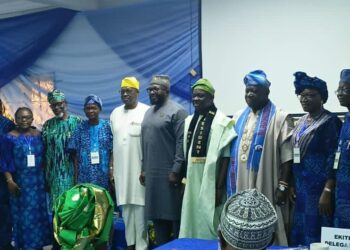
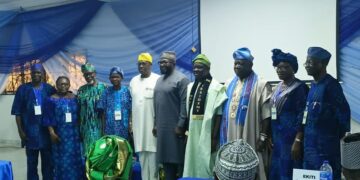


























































There was something unmistakably grand about Saturday’s ceremony at the palace of the Alake of Egbaland in Abeokuta as the distinguished gathering of eminent personalities, traditional leaders, political associates and admirers watched Senator Professor Iyabo Obasanjo receive yet another traditional honour, one that appears to carry a particularly profound significance in the land of her ancestry.

Conferred by His Royal Majesty, Oba Adedotun Aremu Gbadebo, CFR, the Alake and Paramount Ruler of Egbaland, on Saturday, November 21, 2026, the title of First Iyaniwura of Egbaland was more than a ceremonial distinction.
It was a moment of cultural recognition for a woman whose professional, academic, political and public-service journey has traversed Nigeria and the international academic and public health communities.
And as her profile was painstakingly read before the royal audience, the palace atmosphere reportedly became electrifying. The eminent chiefs and guests, many of whom appeared captivated by the breadth of her accomplishments, were virtually swept off their feet by the remarkable trajectory of a woman whose career has straddled veterinary medicine, epidemiology, public health administration, academic research, international development, legislative service and politics.
The encomiums that accompanied the presentation were therefore not merely the customary embellishments of a traditional ceremony. They were, in many respects, a reflection of the extraordinary range of accomplishments that have distinguished Senator Obasanjo’s life.
The conferment, was one of the high points of the traditional ceremony presided over by the Alake.
The reception was a celebration on its own, with an impressive gathering, generous hospitality, sumptuous meals and an extended period of conviviality that brought together political, social and community stakeholders in an atmosphere of excitement.
For many in attendance, the day was not just about the conferment of a title but also about celebrating a woman whose story continues to evoke admiration across different spheres of society.
In her reaction to the conferment, Senator Obasanjo expressed profound gratitude to the Alake and the people of Egbaland, describing the honour as both a privilege and a renewed call to service.
She wrote:
“I am deeply honoured and grateful to His Royal Majesty, Oba Adedotun Aremu Gbadebo, CFR, the Alake and Paramount Ruler of Egbaland, for the distinguished honour of installing me as the First Iyaniwura of Egbaland.”
The senator, whose appreciation was laced with humility, acknowledged the weight of the recognition and the responsibility that comes with it.
“This recognition is one I hold with profound appreciation and a deep sense of responsibility. I do not take this honour for granted, and I remain grateful to the revered traditional institution and the good people of Egbaland for this remarkable recognition.”
Her words underscored a consciousness that traditional titles are not merely adornments or social distinctions but also represent obligations to the community, the preservation of cultural heritage and the promotion of collective advancement.
For Obasanjo, Egbaland represents a rich tapestry of history, culture and heritage, and the title bestowed on her is an invitation to contribute more meaningfully to its development.
“Egbaland is a land rich in history, culture and heritage. To be entrusted with a title of this significance is both a privilege and a renewed call to continue contributing to the growth, unity and development of our people.” She concluded her appreciation with a pledge to uphold the values embodied in the title: “I receive this honour with humility, gratitude and an unwavering commitment to the values it represents. Thank you, Kabiyesi. Thank you, Egbaland.”
That statement, perhaps more than anything else, captured the essence of the occasion: an acknowledgement of personal accomplishment, but also a commitment to community, tradition and service.
The applause that greeted the reading of Senator Obasanjo’s profile at the palace was understandable when viewed against the breadth of her academic and professional achievements.
Few public figures in Nigeria’s political space can boast of such an expansive career that seamlessly combines scientific training, university teaching, public health research, government administration, legislative responsibility and international scholarship.
Her academic journey began at the University of Ibadan, where she obtained her Doctor of Veterinary Medicine degree in 1988. She subsequently proceeded to the United States, where she earned a Master’s in Preventive Veterinary Medicine from the University of California, Davis, in 1992, before completing a PhD in Epidemiology, with a minor in Immunology, at Cornell University, Ithaca, New York, in 1995.
That academic foundation would become the bedrock of an international career in research, public health, health policy and development. Her early professional engagements included clinical practice and lecturing at the School of Veterinary Allied Health, Moore Plantation, Ibadan, between 1988 and 1990, before she moved to Cornell University, where she served as a teaching assistant and statistical and technical consultant.
She later worked as a research associate at the Department of Comparative Medicine, Wake Forest University School of Medicine, Winston-Salem, North Carolina, between 1994 and 1996. Her subsequent engagements in the United States included research, scientific consultancy, clinical research and project management positions at Trilogy Consulting Corporation, Glaxo-Wellcome and Quintiles, among others.
The experience acquired in those institutions helped position her for an eventual return to Nigeria’s public-service arena, where her expertise would be deployed in the administration and development of the health sector.
Between 2003 and 2007, Senator Obasanjo served as Ogun State Commissioner for Health, a period during which she oversaw public health activities across the state. Her responsibilities included supervising government-owned health facilities, managing health personnel and coordinating externally funded programmes.
Among the initiatives under her supervision were the World Bank-funded Health System Development Project II, as well as programmes associated with the eradication of onchocerciasis and Guinea worm disease, supported by the Merck and Carter Foundations respectively.
Her administrative responsibilities extended to a workforce of more than 200 personnel and 28 hospitals owned by the state. It was a period that brought her scientific expertise into direct contact with the practical realities of healthcare administration, public policy, institutional management and service delivery.
That experience would later become particularly relevant during her tenure in the Nigerian Senate. Between June 2007 and June 2011, Senator Obasanjo served as a Senator of the Federal Republic of Nigeria, representing Ogun State and chairing the Senate Committee on Health.
Her legislative experience provided another platform through which she engaged with national health policy, public health advocacy, international partnerships and legislative oversight. During her tenure, she participated in engagements with international development organisations and institutions, including the United Nations Foundation, the Gates Foundation and EngenderHealth, among others, particularly in discussions around polio eradication, measles vaccination and reproductive health.
Her work also involved health advocacy, fundraising initiatives and engagements with organisations operating within the reproductive health space. The Senate years were, therefore, another important chapter in a career that had already combined scientific scholarship and public administration, bringing her into the arena of national policy formulation and legislative oversight.
Following her legislative service, Senator Obasanjo continued to build an impressive academic and leadership profile. Between 2012 and 2013, she was an Advanced Leadership Fellow at Harvard University.
In 2014 and 2015, she served as a Distinguished Fellow at the African Presidential Center, Boston University.
She later joined the Virginia Military Institute as the Thomas Bahnson and Anne Bassett Stanley Visiting Professor in Ethics and Integrity in the Department of International Studies and Political Science.
Her academic engagements also included adjunct teaching in Applied Public Health at the Mary Deming School of Health Sciences, Mary Baldwin University. In 2017, she joined the College of William and Mary, Williamsburg, Virginia, as an Assistant Professor, subsequently rising to Associate Professor with tenure.
At William and Mary, she undertook several academic and institutional responsibilities, including serving as Co-Director of the Center for African Development at the Global Research Institute and as a faculty affiliate of the Africana Studies Programme and the Institute of Integrative Conservation.
In January 2024, she moved to the University of Maryland, Baltimore, where she currently serves as an Associate Professor in the School of Graduate Studies. Her academic work has focused extensively on community health workers, health equity, public health systems, healthcare access, health policy, gender and leadership, among other areas.
The impressive profile presented at the palace also highlighted her substantial contribution to scientific and scholarly literature.
Over the years, Senator Obasanjo has authored and co-authored research articles published in reputable international journals, including Global Public Health, BMC Health Services Research, Globalization and Health, Journal of Community Health, Community Health Equity Research and Policy, World Medical and Health Policy, The Journal of Climate Change and Health and International Journal of Environmental Research and Public Health, among others.
Beyond publications, she has received research grants and institutional awards, including funding for community-engaged research, community health worker training and health equity initiatives.
In May 2026, she received an Institute of Clinical and Translational Research Community Engaged Research Award from the University of Maryland, Baltimore, for a project aimed at training West Baltimore community members for entry-level roles in healthcare and public health.
She has also been involved in grant-supported research and evaluation projects in the United States, South Africa and other areas of international public health research. Her profile also reflects a long record of professional service, academic leadership and institutional engagement.
She has served in different capacities within the American Public Health Association, including as Governing Councilor, Vice-President of the Black Caucus of Health Workers and Section Secretary of the Maternal and Child Health Section.
She has also served on the advisory board of the American Public Health Association’s Center for Climate, Health and Equity and participated in the activities of the Consortium of Universities for Global Health.
In Nigeria, she served as a Non-Executive Director of Unity Bank Plc between 2023 and 2026, where she chaired the Board’s Nominations and Governance Committee.
The combination of these engagements has helped establish her as a figure whose professional interests extend beyond partisan politics into academia, institutional governance, international development, health equity and public policy.
Overall, the event reinforced the visibility of Senator Obasanjo within Ogun State’s political and social landscape at a time when political engagement and grassroots mobilisation remain increasingly consequential.
Yet, beyond the political undertones, the conferment of the title by the Alake was a recognition rooted in the traditional institution and the cultural heritage of Egbaland. The title of Iyaniwura, now conferred on Senator Obasanjo as its first holder in Egbaland, represents a distinguished place within the traditional framework of the community.
Its significance lies not simply in the prestige associated with royal recognition but also in the expectations of service, leadership, cultural preservation and community development that such an honour may embody.
For a woman whose career has been shaped by international scholarship, public service, legislative engagement and institutional leadership, the title provides another avenue through which her relationship with Egbaland may be strengthened.
The palace ceremony was, in many respects, a convergence of two worlds: the traditional institution, with its enduring authority and cultural symbolism, and the contemporary world of science, academia, public policy and political leadership.
And on Saturday, the Alake of Egbaland brought those worlds together in a ceremony that celebrated the accomplishments of Senator Professor Iyabo Obasanjo, while entrusting her with a title that she has pledged to uphold with humility, gratitude and a commitment to the growth, unity and development of Egbaland.