



























































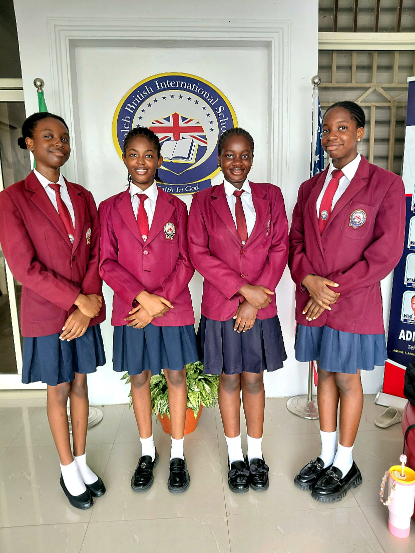
Four CBIS Teenage Students Turn Unused Textbooks into ₦5m Innovation Prize

Four secondary school students of Caleb British International School (CBIS), Abijo, Lagos, have won a ₦5 million grand prize in a national innovation challenge after developing a digital platform designed to make textbooks more affordable and accessible to Nigerian students.
The students—Deborah Iweha, Makayla Inyere, Fife Alonge and Okeke Janelle—emerged national champions at the Zenith Bank Future Innovators Challenge, held as part of Zecathon 6.0, defeating competing finalists from across the country.
Their winning innovation, ReLearn, seeks to address a familiar problem for Nigerian families: the high cost of educational materials and the difficulty many students face in obtaining the textbooks they need.
The platform provides a means of redistributing used textbooks that would otherwise remain unused in homes after the end of an academic session, making them available to other students who need them.
The idea emerged from independent research conducted by the students, including engagement with parents, which helped them identify the financial burden of purchasing schoolbooks as an issue requiring practical intervention.
Explaining the motivation behind the project, Deborah Iweha said the platform would help families reduce educational expenses while ensuring that children had access to the books required for their studies.
Her teammate, Fife Alonge, said ReLearn was also designed to bridge educational gaps by enabling children in underserved communities to obtain quality learning materials at a fraction of the prevailing market price.
Beyond its commercial and social potential, the initiative aligns with three United Nations Sustainable Development Goals: Quality Education, Reduced Inequalities and Responsible Consumption.
The team intends to use its ₦5 million prize money to expand ReLearn beyond the school community, with the ambition of putting thousands more textbooks into the hands of Nigerian students.
The Future Innovators Challenge, organised by Zenith Bank in partnership with Beyond Limits, is designed to expose senior secondary school students to innovation, teamwork, technology and practical problem-solving.
The competition formed part of Zecathon 6.0, with a combined ₦10 million prize pool for the top three schools.
Reacting to the victory, the Director of Caleb Group of Schools, Dr Oladega Adebogun, expressed pride in the students’ achievement, describing them as worthy ambassadors of the institution.
Dr Adebogun attributed the success partly to the school’s investment in information and communications technology infrastructure, including modern ICT learning hubs, technology innovation laboratories and audiovisual facilities.
According to him, the accomplishment reflects the school’s commitment to combining academic excellence with the development of students’ creativity, entrepreneurial abilities and problem-solving skills.
Adebogun also acknowledged the contributions of parents, school management and staff, describing the victory as a collective achievement.
The latest feat adds to a series of distinctions recorded by the Caleb Group of Schools this year.
At the British Council Recognition and Outstanding Learner Awards (BROCLA) 2026, Akota-Chika Serena of CBIS, Magodo emerged Best-in-the-World in IGCSE English, while Adekimi Tolulope Israel of CBIS, Lekki earned the Best-in-the-World distinction in IGCSE Mathematics.
The ReLearn team acknowledged the support of the school’s leadership, including the Director, Dr Adebogun; Head of School, Ms Colette O’Hehir; Principal, Mr Kasimu Rabiu; and Deputy Principal, Mr Oluwabunkumi Ogbowa.
The students were also supported and coached by mentors from the Caleb British International School Young Entrepreneurs Club: its coordinator, Mr Israel Adewuyi; Mr Gbadebo Clement; Mr Adedayo Olaoluwa; Miss Uche Okeke; and Miss Awodiya Dorcas. The school’s Head of Competition, Mr Awoyemi Samuel, also supported the team.
Their achievement highlights the potential of young Nigerians to develop practical solutions to everyday challenges, turning a problem as ordinary as unused textbooks into an opportunity to improve access to education.